

Every growing business eventually hits a wall with their tech stack. You’re juggling spreadsheets, random email tools, and a disconnected sales team, and you realize: We need a real system.
Choosing a Marketing Automation Platform is one of the heaviest decisions a marketing leader makes. It’s not just about buying software; it’s about choosing a philosophy. It’s a marriage that will dictate your budget, your data structure, and your team’s sanity for the next five years.
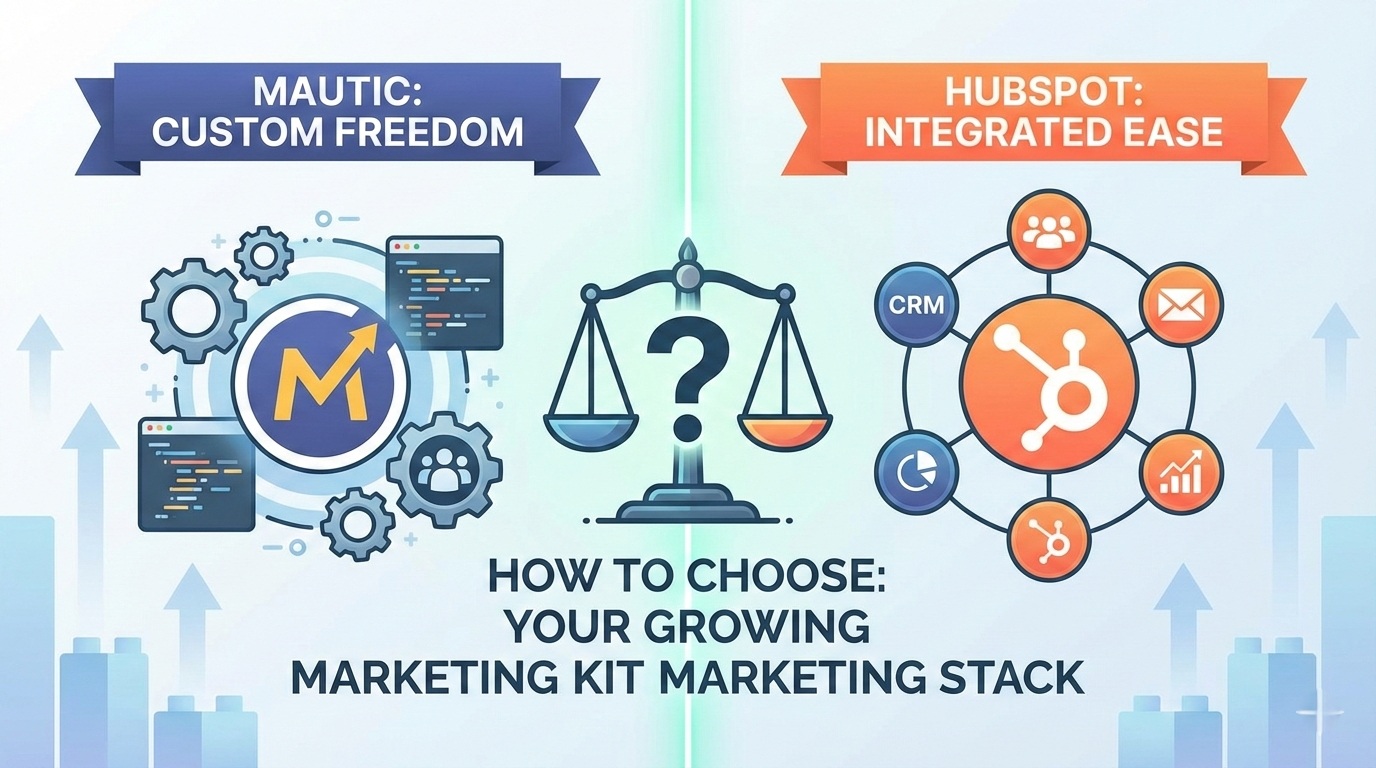
In the red corner, we have HubSpot—the polished, user-friendly giant. In the blue corner, we have Mautic—the flexible, powerful open-source challenger.
This isn’t a battle of “good vs. bad.” It’s a battle of context. Which one actually fits the shape of your business? Let’s break down the Mautic vs. HubSpot debate without the sales fluff.
1. The Philosophy: Walled Garden vs. Open Field
To understand the difference, you have to look at how these platforms were born.
HubSpot is the Apple of the marketing world. It is a sleek, cohesive ecosystem. Their Customer Relationship Management (CRM) tools, CMS, and marketing hubs talk to each other beautifully because they were built to do exactly that. The user interface is gorgeous, the support is top-tier, and things generally just work right out of the box.
But, like Apple, it is a “walled garden.” You play by their rules. If you want a feature they don’t have, you wait for them to build it, or you pay for a third-party app from their marketplace.
Mautic, on the other hand, is the Android (or Linux) of the space. It is the world’s largest Open Source CRM and automation project. The philosophy here is total freedom. Because you have access to the source code, the platform is yours to mold.
Do you want to build a bespoke integration with a legacy internal database? You can. Do you want to rewrite how the email engine processes queues? Go ahead. But with that freedom comes responsibility. You aren’t just the user; you are the captain of the ship.
2. The Scalability Trap: Growing Pains
Success is a double-edged sword in marketing automation. You want more leads, but more leads usually mean higher costs.
HubSpot Pricing is famous for what industry vets call the “success tax.” It starts friendly. The entry-level tiers are inviting. But as your contact list grows from 1,000 to 10,000 to 100,000, the price curve is steep. You are paying for the convenience of their infrastructure. For many companies, this is fine—the ROI justifies the bill. But for businesses with massive databases (like publishers or B2C retail) where revenue per contact is low, the HubSpot bill can become eye-watering.
Mautic Customization and scaling work differently. Because it is self-hosted, you don’t pay per contact. You could have 5 million contacts in Mautic, and the software license cost remains exactly zero.
However, “free” software isn’t free. You are paying for server space (AWS, DigitalOcean, etc.) and, more importantly, you are paying for the talent to manage it. Enterprise Marketing Automation using Mautic requires a developer or a specialized agency to ensure the engine keeps running smoothly as you scale.
3. Customization and the API Frontier
If your sales process is standard, HubSpot’s out-of-the-box workflows are world-class. They’ve perfected the “best practice” templates so you don’t have to.
However, if your business requires deep, non-standard API integration—perhaps connecting to a custom-built legacy database or a niche industry tool—you might hit a wall with HubSpot’s proprietary structure. With Mautic, there are no walls. Because you have full access to the source code, you can build custom triggers, unique tracking logic, and integrations that would be impossible (or incredibly expensive) in a closed SaaS environment.
4. Total Cost of Ownership (TCO): A Reality Check
When comparing these two, looking at the “sticker price” is a mistake. You have to look at the total resources required to make the platform perform.
| Factor | HubSpot | Mautic |
| Licensing | High monthly fees (Scales with contacts) | Free / Open Source |
| Data Sovereignty | Data lives on HubSpot’s servers | You own the data 100% |
| Setup & Maintenance | Low (Marketing-led) | High (IT/Dev-led) |
| Infrastructure | Managed by vendor | Self-managed (AWS, Google Cloud, etc.) |
| Support | 24/7 Professional support | Community-based or paid consultants |
The Verdict: Which Tribe Are You?
So, who wins?
Choose HubSpot if:
- You want speed. You need to launch a campaign tomorrow.
- Your team is non-technical and needs an intuitive interface.
- You value a unified ecosystem where support is just a chat window away.
- You are okay with predictable, albeit higher, ongoing subscription costs.
Choose Mautic if:
- You crave control. You want to tweak the code and build custom workflows.
- You have a massive contact list and HubSpot’s per-contact pricing scares you.
- Data privacy laws require you to host your own data.
- You have access to technical partners who can handle the “plumbing.”
Making the Jump
Whether you go the route of the polished SaaS or the powerful Open Source, the tool is only as good as the strategy behind it. A Ferrari and a Ford both go nowhere without a driver.
Implementation is where most companies fail. They buy the tool and expect magic.
If you are struggling to audit your needs or decide which platform will accelerate your growth, you don’t have to guess. The MarTech specialists at Creativesmug live and breathe this stuff. We help you navigate the noise and build a stack that actually prints money.
Find your perfect fit at www.creativesmug.com.

Leave a Reply